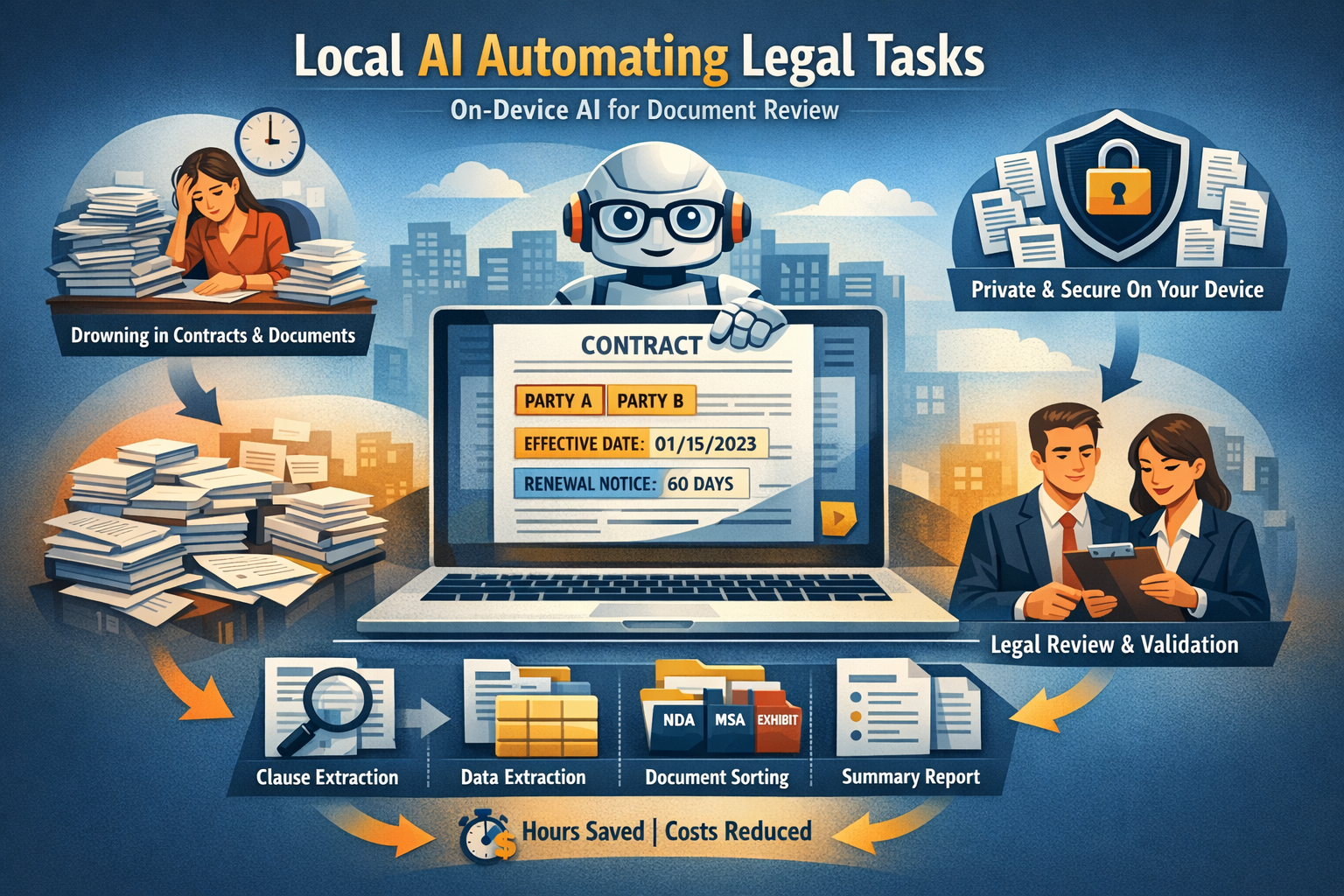
The Problem: Drowning in Repetitive Legal Document Work
Legal teams face a persistent challenge: reviewing hundreds of contracts during due diligence, extracting renewal dates from vendor agreements, or sorting thousands of discovery documents by type and relevance. A paralegal might spend 40 hours manually reading through 200 NDAs to extract party names, effective dates, and confidentiality periods. Corporate counsel preparing for an acquisition must compare 150 supplier contracts against a standard template to identify missing indemnification clauses.
These tasks are time-consuming, error-prone, and expensive. Yet they're also predictable and rule-based—exactly the kind of work where local AI can provide meaningful assistance.
Where AI Is Already Deployed in Legal Work
Legal AI has moved from experiments to everyday practice. Thomson Reuters' 2026 survey found organization-wide AI deployment in professional services doubled from 22% to 40% in a year, and roughly three-quarters of professionals use generative AI weekly; Clio's surveys show solo and small firms adopting at 71-75%. Where is it working today?
- Contract review and lifecycle management: Luminance, Kira, Ironclad, and Harvey already read contracts, flag non-standard clauses, and structure key terms—with vendors reporting up to 90% time savings on routine review (an 80-page MSA reviewed in minutes instead of hours).
- E-discovery and document review: Relativity and similar platforms use AI for technology-assisted review, concept clustering, and privilege-log generation, replacing thousands of hours of manual document coding.
- Legal research: Lexis+ AI, Westlaw Precision AI, and Casetext CoCounsel summarize case law, draft memos, and trace legal history with citation grounding.
- Due diligence and litigation support: AI ingests entire data rooms, flagging liabilities, change-of-control clauses, and compliance gaps in hours instead of associate weeks.
The gaps in this stack aren't features—they're confidentiality, cost, and trust. That's exactly where local AI changes the calculus.
Why These Tasks Are Static
Contract review for clause extraction, document classification, and field normalization follow consistent patterns. When you're identifying parties in an NDA, you're looking for specific sections: "This Agreement is entered into between [Party A] and [Party B]." When categorizing discovery documents, you're matching file types, metadata, and content patterns against known categories.
These tasks don't require legal judgment about whether a clause is enforceable or strategically sound. They require consistent application of rules: find the effective date field, extract the payment terms, flag missing sections, sort by document type. The logic is repeatable across hundreds or thousands of documents.
This deterministic nature makes them ideal candidates for automation—but only when the automation tool respects the sensitive, confidential nature of legal documents.
Why Local AI Is a Good Fit
Cloud legal AI is powerful, but it introduces risks unique to law—and increasingly, courts are noticing:
- Privilege and confidentiality: In 2026, United States v. Heppner (S.D.N.Y.) held that a defendant's independent use of a public generative-AI tool (Anthropic's Claude) to draft defense strategy can waive attorney-client privilege, because public platforms' terms permit data collection and retention. Local AI runs entirely on your network—no third-party API, no retention policy, no exposure of client materials.
- Verification burden: Courts continue to sanction attorneys who file hallucinated citations. Local processing doesn't remove the duty to verify, but it keeps the entire review chain in-house, where outputs can be logged and checked.
- Data residency and governance: GDPR, CCPA, and client agreements can prohibit sending confidential materials to unvetted cloud models. Local AI keeps documents where your security policy says they must stay.
- Cost per document: Enterprise legal AI suites carry per-seat or per-document fees. Local AI processes 500 contracts or 10,000 discovery documents for the cost of electricity.
What you get is the same mechanical capability—extraction, classification, normalization, structured output—without the confidentiality and cost exposure of a cloud pipeline.
What Local AI Actually Does
Local AI performs mechanical, rule-based actions on legal documents:
- Document reading: Processes contracts, agreements, filings, and discovery documents in PDF, Word, or scanned formats
- Field extraction: Pulls party names, effective dates, termination clauses, payment terms, renewal dates, and contract IDs
- Format normalization: Standardizes date formats, clause numbering, and cross-references
- Comparison: Matches contracts against templates to identify missing or inconsistent clauses
- Classification: Sorts documents by type (NDA, MSA, SLA, exhibit, correspondence)
- Summarization: Generates extractive summaries listing key facts, parties, dates, and obligations without interpretation
- Structured output: Exports findings to CSV, JSON, or tables for legal databases and review platforms
Local AI assists the process but does not replace professional legal judgment.
Step-by-Step Workflow: Contract Clause Extraction
Here's how a legal operations team might use local AI to extract key terms from 300 vendor contracts:
- Prepare documents: Collect all vendor contracts in a single folder. Convert scanned PDFs to text using OCR if needed.
- Define extraction rules: Specify which fields to extract: party names, effective date, termination date, payment terms, liability caps, renewal clauses, and governing law.
- Run batch processing: Use a local AI model (like Llama 3 or Mistral) with a prompt template that instructs the model to extract specified fields from each contract. Process documents in batches of 50.
- Review outputs: The model generates structured JSON or CSV output for each contract. A paralegal spot-checks 10% of results to verify accuracy.
- Flag anomalies: Configure the system to flag contracts where key fields are missing or dates appear inconsistent (e.g., termination date before effective date).
- Export to database: Import the structured data into your contract management system or legal database for further review and analysis.
- Human validation: Legal counsel reviews flagged contracts and validates critical terms before relying on extracted data for decision-making.
Realistic Example
A mid-size law firm preparing for a client acquisition needed to review 280 supplier agreements to identify contracts with auto-renewal clauses and extract renewal notice periods. Manually, this would require approximately 70 hours of paralegal time at $75/hour ($5,250).
Using a local AI model running on a standard workstation, the team:
- Processed all 280 contracts in 6 hours of machine time
- Extracted renewal clauses, notice periods, and termination rights into a structured spreadsheet
- Flagged 23 contracts with ambiguous or missing renewal terms for manual review
- Reduced paralegal review time to 12 hours (validating outputs and reviewing flagged contracts)
Total time saved: 58 hours. Cost savings: approximately $4,350. The team maintained complete data privacy and produced auditable, consistent results.
Limits and When NOT to Use Local AI
Local AI is not appropriate for tasks requiring legal judgment, interpretation, or strategic thinking:
- Legal advice: Do not use local AI to determine whether a clause is enforceable, compliant, or strategically favorable
- Contract interpretation: Ambiguous terms, conflicting provisions, or complex legal language require human legal analysis
- Case assessment: Evaluating litigation risk, settlement value, or case strategy demands professional judgment
- Compliance decisions: Determining whether a contract meets regulatory requirements or internal policies requires legal expertise
- High-stakes situations: Critical negotiations, major transactions, or litigation-sensitive documents should not rely solely on automated extraction
Local AI is a tool for mechanical document processing. It accelerates repetitive work but cannot replace the reasoning, judgment, and accountability that licensed legal professionals provide.
Key Takeaways
- Local AI excels at static, high-volume legal document tasks: extraction, classification, comparison, and formatting
- Privacy and cost advantages make local AI practical for legal teams handling sensitive, document-heavy workflows
- Local AI reduces time and errors in repetitive tasks while preserving complete data confidentiality
- It is not a replacement for human legal judgment, interpretation, or strategic decision-making
- Best results come from combining local AI automation with professional legal validation
- Privilege First: contract review, e-discovery, and research are cloud commodities—local AI is where confidentiality, per-document cost, and data residency stay in your hands
Next Steps
If your legal team handles high volumes of contracts, discovery documents, or compliance filings, consider starting with a small pilot project:
- Identify one repetitive, rule-based task (e.g., extracting effective dates from 50 NDAs)
- Set up a local AI model on a secure workstation
- Process a test batch and validate results manually
- Measure time savings and accuracy before scaling
For detailed setup guides and model recommendations for legal document processing, explore our documentation and model selection guide.