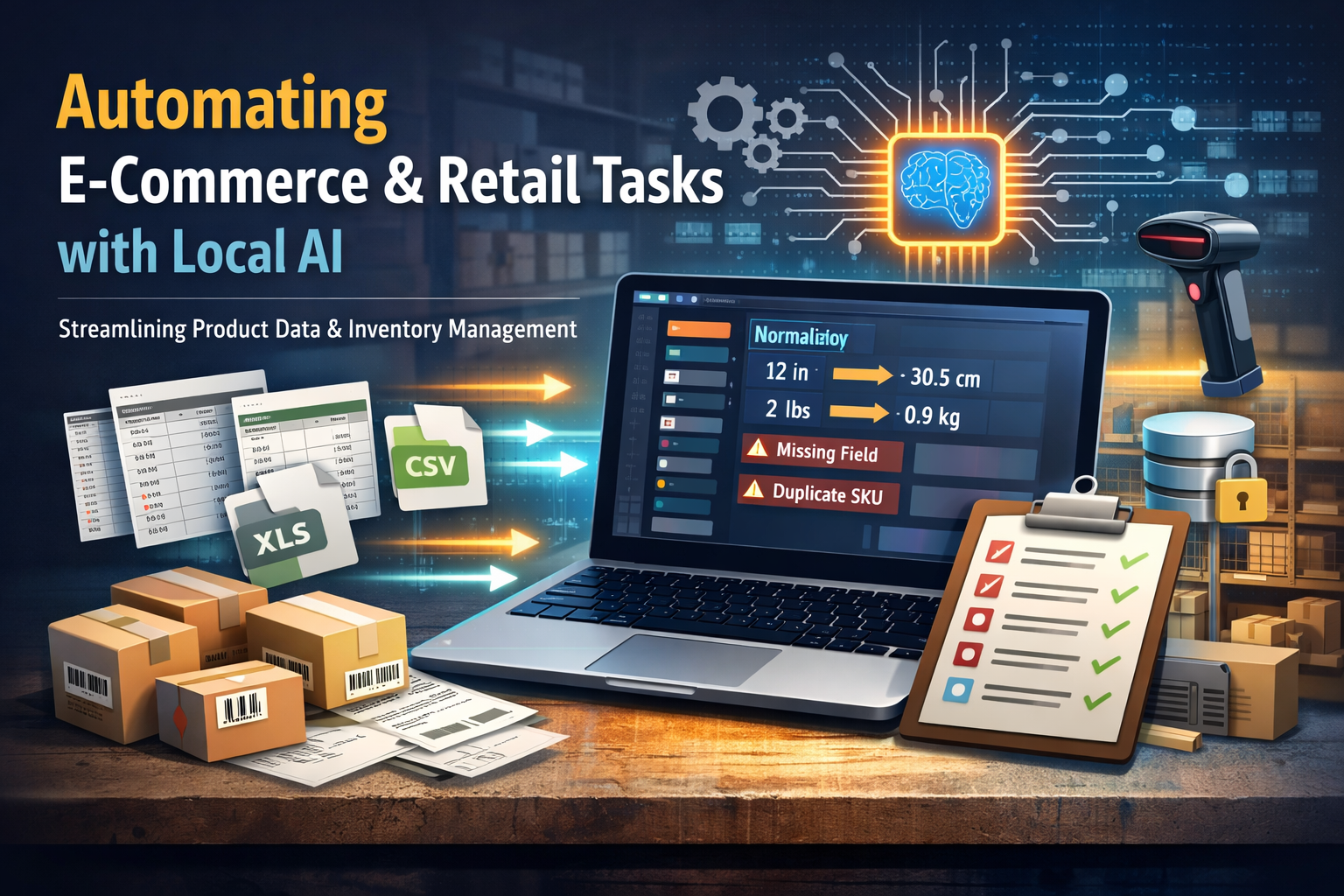
The Product Data Problem
Managing an online store with thousands of products means dealing with endless spreadsheets, supplier feeds, and inventory updates. A mid-size retailer might receive weekly CSV files from five different suppliers, each with different column names, formatting conventions, and data quality issues. Product titles are inconsistent. Dimensions are in mixed units. SKUs don't match across systems.
The operations team spends hours each week cleaning this data, standardizing formats, and reconciling inventory counts. One missing field can break an import. One duplicate entry can create fulfillment errors. The work is tedious, repetitive, and error-prone, but it has to be done.
This is where local AI becomes useful. Not for making business decisions or writing marketing copy, but for handling the mechanical, high-volume data work that follows predictable rules.
Where AI Is Already Deployed in E-Commerce & Retail
Retail is one of the most AI-saturated industries. McKinsey finds 89% of retail and CPG companies using or testing AI, Salesforce reports 84% of retailers using AI in some form, and NRF data shows 73% of consumers now touch AI somewhere in their buying journey. The catch: only about 7% of retailers have fully scaled AI to measurable impact. Where is the mature deployment today?
- Recommendations and personalization: AI-driven recommendations drive an estimated 25-35% of e-commerce revenue—Amazon attributes roughly 35% of its sales to them, and Shopify merchants using session-aware AI typically see 10-20% higher average order value.
- Demand forecasting and inventory: Gartner expects 70% of large organizations to adopt AI-based forecasting by 2030. Real-world results include 20-50% lower forecast error, 20-30% inventory reduction, and far fewer stockouts—Walmart cites a 10% sales lift with 12% lower inventory costs.
- Customer service automation: Roughly half of commerce organizations run AI chatbots that resolve an estimated 80-93% of routine inquiries at $0.50-$2 per interaction versus $6-$13.50 for a human-handled ticket.
- Catalog enrichment and content: Over 90% of e-commerce marketers use generative AI to build titles, descriptions, and localized copy, and merchants with 95%+ data completeness get discovered by AI shopping agents while sparse catalogs get skipped.
- Dynamic pricing: Fewer than 15% of retailers run real-time AI pricing engines, but those that do see 2-10% revenue gains—Amazon alone adjusts prices up to 2.5 million times a day.
The missing layer for most retailers is trust: where customer PII, margin structures, and supplier terms live, and what happens when the internet drops at the point of sale.
Why These Tasks Are Static
Product data management is fundamentally rule-based. When you normalize a supplier feed, you're applying consistent logic:
- Extract product ID, title, price, and stock level from specific columns
- Convert all dimensions to centimeters
- Standardize color names (e.g., "navy blue" becomes "Navy")
- Flag missing required fields
- Match supplier SKUs to internal product IDs
These operations don't require judgment or creativity. They follow deterministic patterns. The same input should always produce the same output. There's no strategic thinking involved—just consistent application of predefined rules across large datasets.
Why Local AI Is a Good Fit
Cloud AI has commoditized the customer-facing layer. What a local engine protects is the layer cloud can't be trusted with:
- Customer PII and privacy: Browsing history, payment data, and behavioral profiles sent to cloud APIs create exposure under GDPR and CCPA. Local AI keeps customer and order data on your own network.
- Price and strategy confidentiality: Your margin thresholds, supplier contracts, and pricing logic are core trade secrets. Feeding them into a public AI API risks them surfacing elsewhere. Local models keep strategy on-site.
- Offline POS and edge latency: In-store tasks like instant fraud checks and local inventory reconciliation need sub-100ms responses and can't depend on store Wi-Fi. Local AI works at the edge, offline.
- Unit economics at low margins: Paying per token or per interaction erodes thin grocery and discount-apparel margins. Local AI processes large catalogs and feeds for the cost of electricity.
What you keep is the same mechanical capability—extraction, normalization, matching, reporting—without the data exposure and per-transaction costs of a cloud pipeline.
What Local AI Actually Does
Local AI for e-commerce is a tool for mechanical data operations. It reads structured or semi-structured product data, applies extraction and transformation rules, and outputs clean, standardized results. Specifically, it can:
- Extract product fields: Pull SKU, title, price, dimensions, weight, stock level, and specifications from supplier feeds
- Normalize formats: Convert mixed units (inches to cm, pounds to kg), standardize date formats, and unify category names
- Match and reconcile: Compare supplier SKUs against internal product IDs, identify matches, and flag new or discontinued items
- Detect data quality issues: Flag missing required fields, zero stock levels, invalid prices, or duplicate entries
- Sort and categorize: Organize products by category, supplier, price range, or stock status based on predefined rules
- Generate reports: Produce structured summaries of inventory levels, data quality issues, or fulfillment status
These are mechanical operations. Local AI doesn't decide which products to stock, how to price items, or which suppliers to use. It processes data according to rules you define.
Step-by-Step Workflow: Processing Supplier Product Feeds
Here's how a retail operations team might use local AI to process weekly supplier feeds:
- Prepare the supplier data: Export the supplier's product feed (CSV or Excel) to a local folder. The file contains products with columns for supplier SKU, product name, wholesale price, stock quantity, and specifications.
- Define extraction rules: Create a prompt template that tells the local AI what to extract and how to format it. Specify required fields, unit conversions, and naming conventions. For example: "Extract SKU, title, price in USD, stock level, dimensions in cm, and weight in kg."
- Batch process products: Feed the supplier data to the local AI in batches of 50-100 products. The model extracts fields, standardizes formats, and flags any missing or malformed data. This runs locally without uploading proprietary supplier information.
- Reconcile with internal catalog: Compare the processed supplier data against your existing product catalog. The local AI identifies matches based on SKU or product name, detects new products, and flags discontinued items.
- Generate data quality report: Have the local AI produce a summary listing products with missing dimensions, zero stock levels, or price discrepancies. This gives the operations team a clear action list.
- Output clean data: Generate a standardized CSV file ready for import into your e-commerce platform. All fields are normalized, formats are consistent, and data quality issues are documented separately.
- Human review and import: The operations team reviews the data quality report, resolves flagged issues, and imports the clean product data. The local AI handled the mechanical processing; humans make the final decisions.
Realistic Example
A home goods retailer receives weekly product feeds from four suppliers, totaling approximately 3,200 products. Each supplier uses different column names, mixed units (inches and centimeters, pounds and kilograms), and inconsistent category naming. The operations team previously spent 6 hours each week manually cleaning this data, standardizing formats, and reconciling inventory.
Using a local AI model running on a standard workstation, the team:
- Processed all 3,200 products in 90 minutes of machine time
- Extracted and standardized product fields (SKU, title, price, dimensions, weight, stock level)
- Converted all dimensions to centimeters and weights to kilograms
- Matched 2,847 products to existing catalog entries based on SKU
- Flagged 353 products requiring manual review (new items, discontinued SKUs, or data quality issues)
- Detected 47 duplicate entries that would have created fulfillment errors
Time saved: 4.5 hours per week. Data quality improved: missing fields decreased from 8% to 2%. The team now processes supplier feeds the same day they arrive instead of batching them weekly. All proprietary product data and supplier pricing remained on the company's internal network.
Limits & When NOT to Use Local AI
Local AI is not appropriate for tasks requiring business judgment, market analysis, or customer interaction:
- Pricing decisions: Do not use local AI to determine product pricing, discount strategies, or competitive positioning
- Product selection: Deciding which products to stock, which suppliers to use, or which items to feature requires market knowledge and business strategy
- Marketing content: Writing product descriptions, creating promotional copy, or developing brand messaging demands creativity and marketing expertise
- Demand forecasting: Predicting sales trends, seasonal demand, or inventory requirements involves complex analysis and market understanding
- Customer service: Handling customer inquiries, resolving complaints, or providing product recommendations requires empathy and problem-solving
Local AI is a tool for mechanical data processing. It accelerates repetitive work but cannot replace the strategic thinking, market knowledge, and customer focus that e-commerce teams provide.
Key Takeaways
- Local AI excels at static, high-volume e-commerce tasks: extraction, normalization, matching, and reporting
- Privacy and cost advantages make local AI practical for retailers handling sensitive supplier data and large product catalogs
- Local AI reduces time and errors in repetitive data processing while keeping proprietary information secure
- It is not a replacement for business strategy, pricing decisions, or customer service
- Best results come from combining local AI automation with human oversight and strategic decision-making
- PII & Margins Stay Home: while recommendations, forecasting, and catalog enrichment run on cloud platforms, the data that funds them—customer PII, margin structures, supplier terms—is exactly what a local engine keeps off the public internet
Next Steps
If your e-commerce operations team handles high volumes of product data, supplier feeds, or inventory reconciliation, consider starting with a small pilot project:
- Identify one repetitive task (e.g., processing 100-200 products from a single supplier feed)
- Define clear extraction rules specifying required fields and format standards
- Set up a local AI model on your workstation (models like Llama 3 or Mistral work well for structured data)
- Process a test batch and validate results manually
- Measure time savings and data quality improvements before scaling
For detailed setup guides and model recommendations for e-commerce data processing, explore our documentation and model selection guide.